


What Is a Semi-Trailer? Structure, Working Principles, and Semi-Trailer vs. Full Trailer
A semi-trailer is an unpowered trailer designed to be coupled to a towing vehicle, with part of its vertical load transferred to the towing vehicle through a coupling system. Unlike a self-propelled truck, a semi-trailer normally has no independent drive system. It works as part of a tractor-trailer combination, in which the prime mover supplies propulsion and steering while the trailer's axles, suspension, wheels, and frame support and distribute the remaining load.
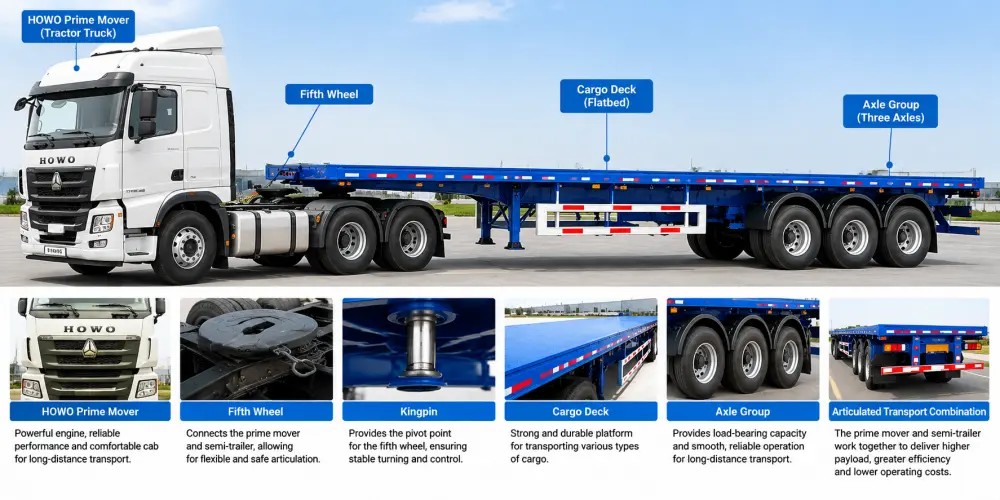
The defining feature of a semi-trailer is its load-bearing connection to the tractor. A kingpin fitted to the front of the trailer engages with the fifth wheel mounted on the tractor. This articulated connection allows the two vehicles to turn relative to each other while transferring the required coupling forces. The exact distribution of vertical load depends on the trailer design, axle arrangement, cargo position, loading condition, and tractor configuration.
For fleet operators, importers, distributors, and transport contractors, understanding this structure is the starting point for choosing equipment that matches the cargo, prime mover, road conditions, and local operating regulations. A trailer that appears suitable by deck length or advertised payload may still be incompatible with the tractor's fifth wheel, axle-load limits, braking connections, or permitted combination dimensions.
Quick answer: A semi-trailer carries cargo on its own chassis and running gear but transfers part of its vertical load to the tractor through the kingpin and fifth wheel. A conventional full trailer, by contrast, generally carries its own vertical load on its axles and connects to the towing vehicle through a drawbar or similar towing arrangement.
If you are evaluating a semi-trailer for a commercial fleet, start with the cargo and operating conditions rather than the trailer name alone. Discuss Your Semi-Trailer Requirements on WhatsApp
What Are the Three Defining Features of a Semi-Trailer?
The three defining characteristics of a semi-trailer are shared load support, an articulated front coupling, and the ability to stand independently when properly supported after uncoupling. Together, these features explain how a semi-trailer differs from both a powered truck and a conventional full trailer.
1. The tractor and trailer share the vertical load
When a loaded semi-trailer is coupled to its tractor, the fifth wheel supports the front portion of the trailer's vertical load. The trailer axle group supports the remaining portion. This arrangement makes the tractor and trailer a connected load-bearing system rather than two vehicles that carry their respective weights independently.
The actual load distribution is affected by the location of the cargo's center of gravity, the distance between the kingpin and axle group, the number and position of axles, and the loading method. Moving heavy cargo forward or backward can change the kingpin load and individual axle loads even when the total cargo weight remains unchanged.
For this reason, payload should never be considered in isolation. The usable payload of a semi-trailer combination must be evaluated against the trailer's permitted loading capacity, tractor ratings, coupling limits, axle loads, tire capacities, gross combination limits, and applicable road regulations.
2. The front connection allows articulation
The kingpin is mounted beneath the front portion of the semi-trailer and engages with the tractor's fifth wheel. Once coupled and locked correctly, the connection allows the tractor and trailer to articulate during turns. The tractor provides the primary steering input, while the trailer follows the tractor's path according to its geometry and operating conditions.
Articulation does not mean that every tractor-trailer combination has the same turning capability. Wheelbase, trailer length, axle placement, tractor configuration, road width, rear overhang, and the swept path of the vehicle all influence maneuverability. These factors become especially important in ports, distribution yards, construction sites, mines, and narrow access roads.
3. Landing legs support the uncoupled trailer
When a semi-trailer is disconnected from its tractor, its front section generally relies on landing legs to remain upright. The landing legs must be deployed according to the manufacturer's instructions and the actual parking conditions. Ground bearing capacity, surface slope, support-pad placement, cargo distribution, and the condition of the landing gear all matter.
Before uncoupling, the operator must secure the vehicle, confirm the trailer is properly supported, and follow the specified parking and coupling procedures. An unsuitable surface or incorrectly operated landing gear can cause instability. Landing legs are designed for their specified support function; they should not be treated as unrestricted lifting equipment unless the equipment is expressly designed and approved for that use.
How Does a Semi-Trailer Work With a Tractor?
A semi-trailer operates through several connected systems: the mechanical coupling, chassis and running gear, braking system, electrical connections, and, where fitted, pneumatic or hydraulic equipment. Correct operation depends on compatibility across these systems, not simply on whether the kingpin physically fits the fifth wheel.
The coupling process
Before coupling, the tractor and trailer should be positioned on suitable ground, and the operator should follow the applicable vehicle and coupling procedures. The fifth wheel height must be appropriate for the trailer, and the kingpin must engage the coupling mechanism correctly. After coupling, the locking mechanism must be checked using the manufacturer's prescribed method.
The operator should also connect and verify the specified air and electrical lines, inspect the landing gear, and confirm that the trailer's brakes and lights function correctly. A visual check alone may not establish that every internal locking component is engaged. The manufacturer's procedure and the applicable safety requirements remain the controlling references.
Before dispatch, the driver should confirm that the trailer is suitable for the intended cargo, the load is secured, the cargo distribution is acceptable, and the tractor-trailer combination complies with relevant limits. These checks are particularly important when changing tractors, handling unfamiliar equipment, or moving trailers between fleets with different specifications.
How load distribution affects operation
Load distribution determines how much vertical load acts on the fifth wheel and how much is carried by the trailer axles. If cargo is positioned incorrectly, one axle group may exceed its permitted load even when the total vehicle weight is within a nominal limit. Excessive or insufficient kingpin loading can also affect the tractor's axle loads and the handling characteristics of the combination.
Consider a trailer carrying several pieces of industrial machinery. Placing the heaviest machine directly over an appropriate structural support area may help achieve the intended load distribution, but its final position must be determined from the actual trailer geometry, cargo weight, axle arrangement, and legal limits. The loading plan should account for each item rather than treating the cargo as a uniform mass.
For procurement teams, the practical lesson is straightforward: request the relevant loading diagram, dimensional information, axle configuration, and rated capacities before committing to a trailer design. A generic payload figure cannot replace a vehicle-specific loading assessment.
What Is the Difference Between a Semi-Trailer and a Full Trailer?
The main difference between a semi-trailer and a full trailer is how the trailer's vertical load is supported and transferred to the towing vehicle. A semi-trailer transfers part of its vertical load through the tractor's fifth wheel. A conventional full trailer, often configured as a drawbar trailer, generally supports its vertical load through its own axles, while the drawbar primarily transmits towing forces and any vertical forces associated with its particular design.
Terminology can vary across markets and regulatory systems. A buyer should therefore compare the actual coupling design, axle arrangement, load ratings, and vehicle-combination requirements rather than relying exclusively on the terms used in a sales listing.
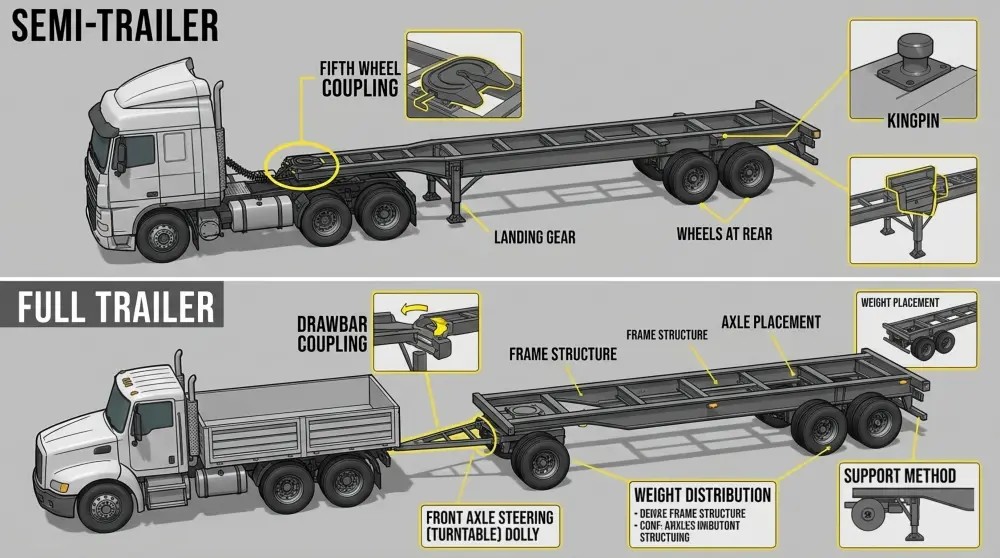
Does a semi-trailer always offer better stability?
No universal stability ranking can be made from the trailer category alone. Stability and handling depend on the complete vehicle combination, including the tractor, trailer geometry, axle configuration, suspension, tires, braking system, cargo position, road surface, speed, and environmental conditions. A well-matched combination operated within its limits may perform differently from an incorrectly loaded or incompatible one.
Likewise, it is not accurate to claim that every full trailer is unsuitable for high-speed operation or that every semi-trailer can carry a particular gross weight. Permitted speeds, dimensions, axle loads, and gross combination weights depend on the vehicle's design and the laws governing its operation.
Which configuration should a fleet operator choose?
A semi-trailer is a logical option when the fleet's operating model is built around compatible tractor units, interchangeable trailers, and an articulated transport combination. A drawbar trailer may be appropriate where the vehicle design, duty cycle, towing arrangement, and applicable regulations favor that configuration.
The decision should be based on route requirements, cargo handling, vehicle availability, site access, coupling compatibility, maintenance resources, and the permitted vehicle combination. Neither configuration should be selected solely because its name is familiar or because a supplier advertises a higher headline payload.
What Are the Main Types of Semi-Trailers?
Different semi-trailer designs serve different cargo-handling and transport requirements. The correct type depends on the physical dimensions of the cargo, loading and unloading equipment, cargo containment needs, axle loading, route conditions, and the regulations that apply to the intended market.
Flatbed semi-trailer
A flatbed semi-trailer has an open deck that accommodates cargo loaded from the top or sides, subject to the available equipment and loading plan. Typical cargo may include construction materials, steel products, timber, industrial components, and machinery that can be secured appropriately on the deck.
Buyers should evaluate deck dimensions, deck height, structural capacity, lashing points, axle configuration, and the permitted distribution of concentrated loads. A nominal payload rating does not automatically establish that a flatbed can support a heavy machine concentrated on a small footprint.
Side-wall and fence semi-trailer
Side-wall and fence configurations provide side containment for compatible general cargo. Depending on the design, they may support the transport of bagged goods, palletized products, building materials, agricultural commodities, and other cargo that benefits from a bounded loading area.
Before ordering, confirm the wall height, gate arrangement, floor design, cargo restraint provisions, and loading method. Side walls should not be treated as substitutes for a suitable cargo-securing system, and removable components must be used within the manufacturer's design limits.
Container chassis semi-trailer
A container chassis is designed to carry compatible shipping containers through specified container-support and locking arrangements. It is commonly used in port drayage, container terminals, inland depots, and road freight operations linking maritime and inland transport.
Container dimensions, locking positions, chassis configuration, axle loads, fifth-wheel height, and permitted overall dimensions must match the intended container and tractor combination. Buyers operating across borders should verify local container-transport rules rather than assuming that a chassis legal in one country is automatically compliant in another.
Dump or tipper semi-trailer
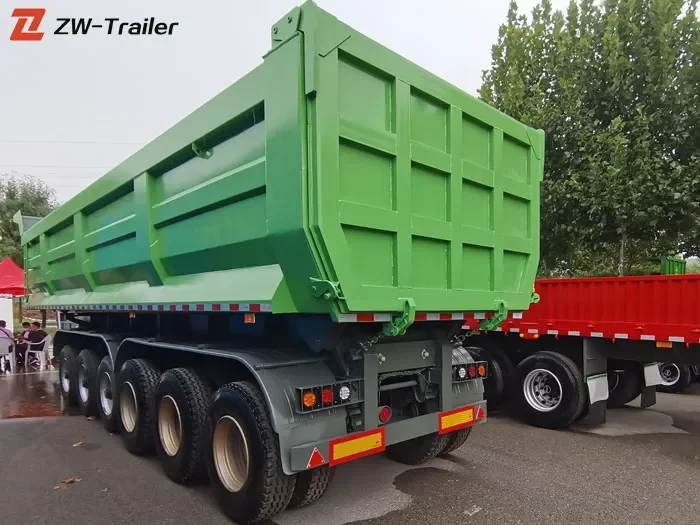
A dump semi-trailer is designed to discharge compatible bulk material by raising its body through a hydraulic tipping system. Typical applications include sand, gravel, aggregates, soil, and other bulk materials, subject to the body design and operating conditions.
The hydraulic cylinder, body structure, hinge points, chassis, and stability of the complete vehicle are all important. Tipping on uneven or weak ground, operating under unsuitable overhead conditions, or raising the body with a poorly distributed load can create serious hazards. The trailer must be operated on an appropriate surface and in accordance with its instructions.
Tanker semi-trailer
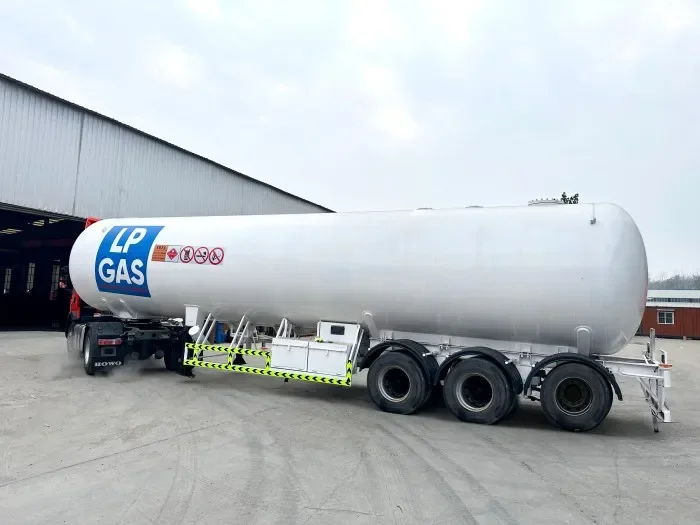
A tanker semi-trailer carries liquids or other specified bulk products in a purpose-designed tank. Product compatibility, tank construction, compartment layout, loading and discharge connections, cleaning procedures, and the applicable transport rules determine whether a tanker is suitable for a particular cargo.
Fuel, food-grade liquid, chemical, and gas transport requirements are not interchangeable. Buyers should identify the exact substance, relevant properties, operating conditions, required approvals, and unloading system before requesting a quotation. The tank's appearance alone cannot establish that it is suitable for a particular product.
Lowbed and low-loader semi-trailer
A lowbed semi-trailer is designed for compatible heavy or oversized equipment that benefits from a lower loading platform. Depending on the configuration, it may be used to transport construction machinery, industrial equipment, and other loads requiring specialized loading arrangements.
Selection depends on the cargo's weight, dimensions, ground clearance, center of gravity, loading method, ramp arrangement, axle configuration, and route restrictions. A machine's operating weight is only one input; its transport dimensions and the way its weight is distributed across the deck can be equally important.
Specialized semi-trailers
Specialized designs include extendable trailers, modular heavy-haul equipment, side-loader container trailers, livestock trailers, and other configurations built for particular transport tasks. Each introduces additional interface requirements, operating procedures, or maintenance considerations.
A side-loader, for example, must be evaluated as an integrated system involving the trailer chassis, lifting equipment, container compatibility, stabilizing arrangements where fitted, and the ground conditions at the handling site. A specialized trailer should be specified around the complete work process, not selected from a product photograph alone.
Need help matching a semi-trailer to a specific cargo or route? Send Your Cargo and Tractor Details on WhatsApp
How Do You Choose the Right Semi-Trailer for Your Business?
The right semi-trailer is the one that satisfies the cargo, vehicle, route, operating, maintenance, and legal requirements of the intended job. Buyers should establish these requirements before comparing supplier prices, because two trailers with similar dimensions may differ substantially in configuration, service needs, and suitability for a particular operation.
Start with the cargo rather than the advertised payload
Record the cargo's actual weight, length, width, height, center of gravity where relevant, loading method, unloading method, and restraint requirements. Determine whether the cargo is concentrated, distributed, liquid, loose bulk, fragile, or sensitive to contamination. These details determine which body structure and support arrangement are appropriate.
For example, a heavy excavator and a load of bagged agricultural products may have similar total weights but require very different trailers. The excavator may need a low loading deck, suitable ramps, and careful distribution of concentrated wheel or track loads. Bagged products may instead require a compatible floor, suitable side containment, and effective cargo restraint.
Confirm the tractor and coupling compatibility
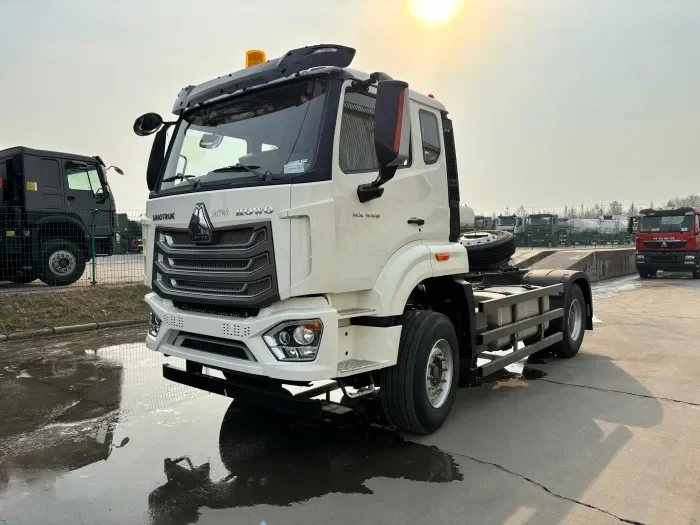
Do not order a semi-trailer without checking the tractor's fifth-wheel rating, coupling dimensions, mounting height, permitted axle loads, and other relevant vehicle specifications. The kingpin and fifth wheel must be compatible, and the combined vehicle must satisfy the applicable ratings and operating restrictions.
The tractor's engine output is not a substitute for checking its chassis and combination ratings. A tractor may be able to move a trailer under some conditions without that combination being legally permissible or appropriate for the intended duty. Buyers should assess the entire combination, including the engine and transmission requirements, braking connections, tire capacities, and route conditions.
Select the axle group and suspension for the duty cycle
Axle count alone does not establish usable payload or legal capacity. The permitted axle loads, axle spacing, suspension design, tire ratings, and local regulations all influence the final result. An additional axle can change load distribution, but it does not automatically authorize a higher gross vehicle weight in every market.
Suspension selection should reflect the operating environment, cargo requirements, road conditions, and maintenance resources. Mechanical and air suspension systems have different designs and service considerations. The best choice depends on the actual application rather than a universal claim that one type is always superior.
Evaluate the main beams and body structure
The chassis transfers loads between the coupling area, body supports, suspension mounting points, and axle group. Buyers should review the structural arrangement, specified materials, fabrication requirements, weld inspection procedures, and corrosion protection appropriate to the application.
High-tensile steel may be specified in some structural designs, but the material name alone does not establish the load capacity or durability of a finished trailer. Material grade, thickness, design geometry, fabrication quality, weld details, and loading conditions all contribute to structural performance. Claims about a specific steel grade or rated capacity should be supported by the relevant technical documentation.
Check braking, tires, and serviceability
The semi-trailer's braking equipment must be compatible with the tractor and the applicable requirements for the intended market. Review the specified brake type, air connections, control arrangements, wheel-end components, and any required anti-lock braking or electronic systems. The presence of a particular component does not, by itself, prove that the complete vehicle meets every regulatory requirement.
Tire size, load rating, availability, and service support also matter. A specification that performs well on paper may create unnecessary downtime if replacement tires, brake components, bearings, suspension parts, or specialist hydraulic components are difficult to obtain in the destination market.
Account for road conditions and local regulations
A trailer intended for highway freight may face different demands from equipment used on rough access roads, mine approaches, construction sites, or port yards. Road surface, gradients, turning space, ground clearance, weather exposure, and the availability of repair facilities should inform the specification.
Before placing an export order, confirm the destination country's requirements for vehicle dimensions, axle loads, gross combination weight, lighting, braking, registration, inspection, and any vehicle-specific approvals. The buyer or importer should also establish which documents are required for customs clearance, registration, and local operation. These requirements vary by market and vehicle configuration.
Compare total operating cost, not just the purchase price
The purchase price is only one component of the cost of owning and operating a semi-trailer. Buyers should consider fuel and tire implications of the overall combination, scheduled maintenance, replacement parts, downtime, repair access, cargo-handling efficiency, and the expected operating life under the intended duty cycle.
For an export fleet, a lower initial price may be attractive, but the decision should be based on comparable specifications and documented scope. A quotation that excludes important components, uses different axle ratings, or assumes a different brake configuration is not directly comparable with a more complete offer. Ask suppliers to identify inclusions, exclusions, optional equipment, warranty conditions, and the documents provided with delivery.
Semi-Trailer Procurement Checklist
- Define the cargo type, actual weight, dimensions, and loading method.
- Confirm the intended tractor model and fifth-wheel compatibility.
- Specify trailer length, deck or body configuration, and required clearances.
- Check axle arrangement, suspension, tires, and applicable load limits.
- Identify the braking, lighting, electrical, and hydraulic requirements.
- Confirm the destination market's road regulations and documentation requirements.
- Compare the complete equipment scope, spare-parts access, warranty, and delivery terms.
- Request the drawings, technical specifications, and inspection documents relevant to the order.
What Should Buyers Inspect Before Accepting a Semi-Trailer?
A pre-delivery inspection should verify that the supplied semi-trailer matches the approved order and that its relevant systems are in acceptable condition. The inspection scope should be agreed in advance and should distinguish between visual checks, dimensional verification, functional tests, and any formal testing required by the contract or applicable regulations.
Begin by comparing the trailer's identification details, configuration, and fitted equipment with the purchase specification. Check the overall structure for visible damage, deformation, corrosion, incomplete assembly, or other discrepancies. Review the coupling components, landing legs, suspension mounting areas, wheels, tires, lighting, braking connections, and any body-specific equipment.
For a dump semi-trailer, the inspection may need to cover the hydraulic power and control arrangements, cylinder installation, hose routing, body pivots, and safe operation under the manufacturer's prescribed procedure. A hydraulic cylinder pressure test or other formal test should only be claimed as completed when the actual procedure, test conditions, results, and acceptance criteria are documented. A visual inspection alone does not prove cylinder pressure performance.
Similarly, a photograph of a weld does not establish the structural capacity of the chassis, and a statement that a trailer has been inspected does not identify what was checked. Buyers should request the inspection records and test evidence that are relevant to the contracted scope rather than relying on broad claims such as “fully tested” without supporting detail.
How to reduce specification disputes
Many procurement disagreements begin when the buyer and supplier interpret the same specification differently. Prevent this by confirming key requirements in writing before production, including the trailer type, dimensions, axle configuration, major components, material requirements where applicable, paint or corrosion protection, accessories, and documentation.
Where a feature is critical to the intended operation, identify its acceptance criteria. For example, if a trailer must accommodate a particular container size, the relevant dimensions and locking arrangement should be specified. If it must work with an existing tractor fleet, the coupling and interface requirements should be documented rather than left to assumption.
Photographs and drawings can help clarify the agreed configuration, but they should correspond to the actual order and should not replace technical records where formal verification is required. Any deviation from the approved specification should be reviewed before acceptance.
Why Do Export Buyers Need to Check Semi-Trailer Documentation?
Export buyers need to confirm that the supplied semi-trailer, its documentation, and its declared configuration match the requirements of the destination market. A vehicle that is suitable for one jurisdiction may need a different specification or additional documents for another. Customs release, vehicle registration, and authorization for road use are separate processes, and completing one does not automatically satisfy the others.
Before shipment, the buyer and seller should agree on the commercial and technical documents required for the transaction. Depending on the contract, destination, and vehicle type, these may include a commercial invoice, packing list where applicable, transport documents, certificate of origin where required, product identification information, technical specifications, and other documents requested by the relevant authorities or importing party.
Vehicle-specific approvals, conformity documents, inspection records, and registration requirements must be checked against the actual destination rules. Buyers should not assume that a general product brochure or a document issued for another model is sufficient evidence of compliance.
What should be agreed before shipment?
- Product identity: Confirm the trailer type, configuration, identification details, and ordered quantity.
- Technical scope: Check dimensions, axle arrangement, coupling details, major components, and specified accessories.
- Inspection records: Identify the checks and test records required under the contract.
- Shipping information: Confirm the agreed delivery terms, shipping arrangements, loading method, and document responsibilities.
- Destination requirements: Verify the applicable import, registration, and road-use requirements with the relevant authorities or qualified local partners.
- After-sales arrangements: Clarify warranty coverage, spare-parts support, technical communication, and the procedure for reporting discrepancies.
For international buyers, the objective is to eliminate avoidable uncertainty before the equipment leaves the supplier. A clear technical specification and document checklist make it easier for the parties to confirm what has been ordered, what has been inspected, and what must be completed before the vehicle can enter service.
Contact ZW Group About Your Semi-Trailer Export Requirements
How Does a Semi-Trailer Differ Before and After Proper Specification Planning?
The commercial value of specification planning becomes clearer when comparing a purchase based mainly on a headline price with a purchase based on defined operating requirements. The following examples describe typical procurement risks and preventive measures; they are not claims about a particular customer project or measured financial result.
The benefit of this process is better control over technical fit, purchase scope, and acceptance. It does not guarantee that every operating issue can be eliminated, but it provides a clearer basis for making a purchasing decision and resolving discrepancies.
When Should You Replace or Upgrade a Semi-Trailer?
A semi-trailer should be evaluated for repair, refurbishment, upgrading, or replacement when its condition, configuration, or maintenance requirements no longer meet the needs of the operation. Age alone does not determine whether a trailer remains suitable. Structural condition, maintenance history, availability of replacement parts, compliance status, downtime, and the cost of restoring the equipment are all relevant.
For an existing fleet, begin with a condition assessment covering the chassis, coupling components, axle group, suspension, brakes, tires, lighting, landing gear, and body-specific systems. Look for visible damage, unusual wear, corrosion, cracks, air leaks, hydraulic leaks, or signs that previous repairs require further evaluation. Any safety-critical defect should be assessed by a competent person before the trailer returns to service.
Upgrading may be practical when the existing chassis and primary structure remain suitable and the required change is compatible with the manufacturer's design and applicable regulations. However, replacing a component with one that has a higher advertised rating does not automatically increase the permitted capacity of the complete trailer. Changes to axles, suspension, brakes, tires, coupling equipment, or structural components require an assessment of the whole system.
Replacement may be more appropriate when the trailer cannot meet the intended duty safely or legally, when essential parts are no longer supportable, or when restoration costs and downtime are disproportionate to the value of the equipment. The decision should compare realistic repair and replacement costs on a consistent basis and include the expected operating requirements of the fleet.
Frequently Asked Questions About Semi-Trailers
What is a semi-trailer in simple terms?
A semi-trailer is an unpowered trailer that connects to a tractor through a coupling such as a kingpin and fifth wheel. It carries cargo on its chassis and running gear while transferring part of its vertical load to the tractor.
Does a semi-trailer have its own engine?
A conventional semi-trailer does not have its own propulsion engine. It depends on a compatible towing vehicle for movement. Some specialized trailer systems may include powered auxiliary equipment, but that does not make the trailer a self-propelled road vehicle.
What is the purpose of a kingpin?
The kingpin is the trailer-side coupling component that engages with the tractor's fifth wheel. It provides the mechanical connection through which towing forces and the required vertical load are transferred. Its dimensions, rating, condition, and compatibility must be checked.
What does a fifth wheel do?
The fifth wheel is the tractor-mounted coupling that receives and locks around the semi-trailer's kingpin. It supports the specified coupling loads and allows articulation between the tractor and trailer. Correct engagement and compatibility are essential.
What is the difference between a semi-trailer and a full trailer?
A semi-trailer transfers part of its vertical load to the tractor through the coupling. A conventional full trailer generally supports its vertical load through its own axles and connects to the towing vehicle through a drawbar or another compatible towing arrangement.
How many axles does a semi-trailer need?
The required axle configuration depends on the intended cargo, trailer design, axle ratings, load distribution, tractor combination, and local regulations. Axle count alone does not determine the legal payload or total permitted weight.
Can one semi-trailer work with different tractor units?
It may be possible if the tractors and trailer are compatible in coupling dimensions and ratings, fifth-wheel height, braking and electrical interfaces, and applicable vehicle-combination limits. Each combination must be checked before operation.
Which semi-trailer is suitable for construction machinery?
A lowbed or low-loader configuration is often considered for heavy construction machinery because its loading platform can accommodate equipment that requires a lower deck. The correct choice depends on machine weight, dimensions, loading method, axle loads, route restrictions, and the complete vehicle's permitted ratings.
Is a higher payload rating always better?
No. A higher advertised payload is not useful if the trailer is incompatible with the tractor, unsuitable for the cargo, or outside the legal limits of the intended route. Buyers should compare the complete vehicle combination and its actual operating requirements.
What documents should I request when buying an export semi-trailer?
Agree on the required documents before ordering. Depending on the contract and destination, these may include the commercial invoice, shipping documents, technical specification, vehicle identification information, relevant inspection records, and documents needed for import or registration. The exact requirements should be verified for the destination market.
How can I request a semi-trailer quotation?
Provide the trailer type, cargo, required dimensions, expected loading conditions, intended tractor details, axle configuration, destination country, and any special compliance or documentation requirements. More complete inputs allow the supplier to evaluate the specification and identify outstanding questions before preparing a comparable quotation.
Discuss Your Semi-Trailer Requirements With ZW Group
Choosing the right semi-trailer begins with a clear understanding of the cargo, tractor, coupling interface, axle loads, operating environment, and destination requirements. These factors should be confirmed before comparing equipment prices or finalizing an export order.
When preparing an inquiry, include the intended application, cargo dimensions and weight, preferred trailer configuration, destination market, and any existing tractor specifications. If you have a reference drawing or a detailed equipment requirement, provide it for review so that the proposed configuration can be assessed against your actual operating needs.