
How to Choose the Right 4 Axle Low Bed Semi Trailer for Heavy Equipment Transportation
Selecting the wrong low bed trailer can lead to frame failure, tire blowouts, expensive downtime and unexpected repair costs. This complete buying guide explains how professional fleet owners, mining contractors and heavy equipment transport companies choose the right 4 axle low bed semi trailer for demanding projects across Africa, the Middle East and international markets.
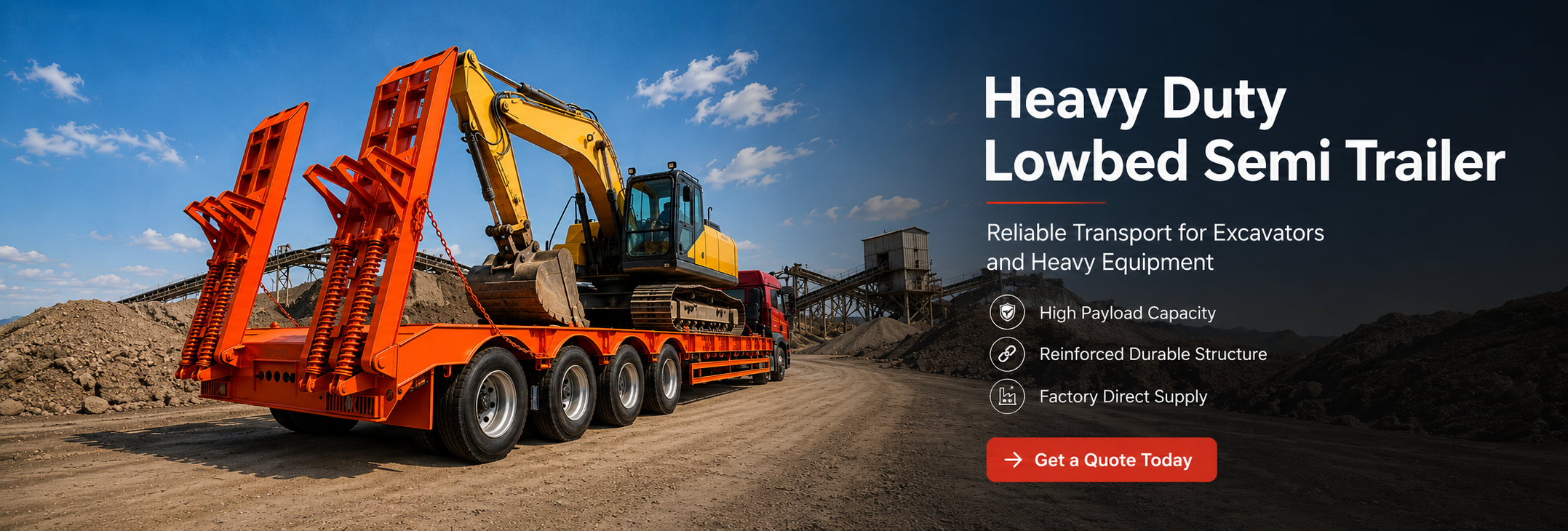
Why Choosing the Right 4 Axle Low Bed Semi Trailer Matters
The first purchasing decision should always be based on actual working conditions instead of price. Many buyers focus on initial investment while overlooking structural strength, axle capacity, suspension reliability and maintenance costs. These overlooked factors become extremely expensive once the trailer begins operating in mining regions, construction projects or cross-border transportation routes. In countries such as the Democratic Republic of Congo, Zambia, Tanzania, Mozambique and Guinea, trailers frequently travel on gravel roads, muddy access roads and uneven mining sites. A highway-oriented lightweight trailer that performs well on paved roads may suffer serious structural fatigue after only a few months under these conditions. Professional transport companies therefore evaluate the trailer from a mechanical engineering perspective rather than simply comparing specifications on paper. The main beam, gooseneck reinforcement, suspension geometry, kingpin structure, landing gear strength and axle distribution all work together to determine whether the trailer can safely carry 80 to 100 tons over thousands of kilometers.
Quick Answer
For most mining applications transporting crawler excavators, bulldozers, drilling rigs and oversized machinery, the recommended configuration includes:
Rated payload between 80 and 100 tons
High-tensile Q345B or T700 welded main beams
Four heavy-duty axles rated above 16 tons each
16 heavy-duty tube tires for rough terrain
Mechanical reinforced suspension
Double reinforced gooseneck structure
Heavy-duty loading ramps
Extra cross members in high stress areas
How to Select the Correct Load Capacity
Choosing the correct payload rating is the foundation of trailer selection. Many overseas buyers mistakenly purchase an 80-ton trailer because their equipment weighs approximately 70 tons. This calculation ignores fuel, attachments, spare parts, uneven loading, dynamic impact loads and road vibration. A crawler excavator rarely distributes weight evenly across the trailer deck. Concentrated loads beneath the tracks create localized stress that can exceed design limits even when the total vehicle weight appears acceptable. Professional manufacturers therefore calculate structural safety using dynamic loading coefficients rather than static equipment weight alone. This engineering approach significantly extends trailer service life under real operating conditions.
| Equipment | Typical Weight | Recommended Trailer |
|---|---|---|
| Wheel Loader | 35-45 Tons | 60T Low Bed Trailer |
| Crawler Excavator | 60-80 Tons | 80-100T 4 Axle Low Bed Trailer |
| Mining Bulldozer | 75-90 Tons | 100T Reinforced Low Loader |
| Drilling Rig | 90+ Tons | Customized Heavy Haul Trailer |
Need Help Choosing the Correct Configuration?
Every mining project has different transportation requirements. Our engineering team can recommend the correct axle specification, beam thickness, deck length, suspension type and ramp design based on your equipment model and destination country.
Simply send us:
Equipment model
Operating country
Estimated payload
Road conditions
Preferred Incoterm (FOB, CIF or CFR)
Our engineers will prepare a customized technical proposal together with detailed drawings and a competitive factory quotation.
How Does Axle Configuration Affect the Safety of a 4 Axle Low Bed Semi Trailer?
The axle system is the foundation of every heavy haul trailer. Even the strongest main beam cannot compensate for poor axle selection or incorrect load distribution. For mining contractors, heavy equipment rental companies and international logistics operators, axle configuration directly determines transportation safety, tire life, braking performance and long-term operating costs. A professional 4 axle low bed semi trailer designed for 80–100 ton transportation should never be evaluated simply by counting the number of axles. Buyers should carefully verify the axle manufacturer's rating, axle spacing, wheel track, bearing capacity, brake chamber configuration, hub quality and compatibility with locally available spare parts. Many low-cost trailers use standard highway axles with lower safety margins. Under continuous overload conditions commonly seen in African mining operations, axle tubes may permanently deform, wheel bearings overheat and brake drums crack, eventually leading to expensive downtime.
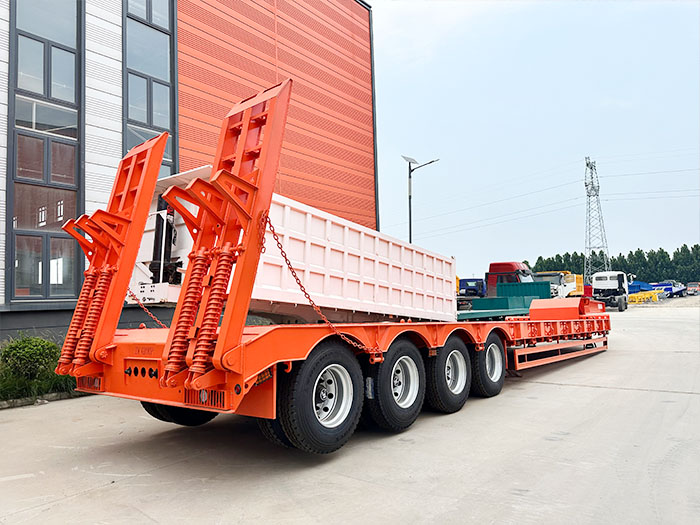
Recommended Heavy-Duty Axle Specification
| Component | Recommended Specification | Benefit |
|---|---|---|
| Axle Capacity | 16T–20T Heavy Duty Axle | Higher structural safety factor |
| Brake System | Large Brake Drum with Dual Chamber | Stable braking on mountain roads |
| Hub Bearings | Heavy Roller Bearings | Longer maintenance interval |
| Slack Adjuster | Automatic Adjustment | Improved braking consistency |
| ABS | Optional WABCO System | Enhanced emergency braking stability |
Why Double Tires Are Essential for Heavy Mining Transportation
For trailers transporting crawler excavators, mining bulldozers and drilling equipment weighing more than 80 tons, a dual-wheel configuration is the preferred solution. Sixteen tires distribute the load over a larger contact area, reducing ground pressure and minimizing the risk of tire failure on gravel roads, muddy construction sites and uneven terrain. Compared with single-tire configurations, dual tires improve overall stability, reduce heat buildup and significantly decrease the possibility of sidewall damage caused by sharp rocks commonly found in mining regions. Proper tire distribution also reduces stress concentrations on suspension components and axle bearings, extending the service life of the entire trailer.
Engineering Insight
Field experience shows that more than 90% of premature tire failures during heavy equipment transportation are related to excessive point loading, incorrect inflation pressure or unsuitable tire specifications rather than manufacturing defects. Selecting the appropriate tire for the operating environment is therefore just as important as selecting the trailer itself.
12.00R20 Tube Tires vs 315/80R22.5 Tubeless Tires
One of the most common questions from overseas buyers concerns tire selection. The correct answer depends entirely on road conditions rather than personal preference. Mining haul roads, quarry access routes and remote construction sites require maximum resistance to impact, sidewall cuts and punctures. Highway logistics operations, on the other hand, prioritize fuel economy and long-distance driving efficiency.
| Comparison Item | 12.00R20 Tube Tire | 315/80R22.5 Tubeless Tire |
|---|---|---|
| Best Road Condition | Mining Roads | Highways |
| Puncture Resistance | Excellent | Good |
| Fuel Economy | Moderate | Excellent |
| Repair Convenience | Easy in Remote Areas | Requires Better Service Facilities |
| Recommended Markets | Congo, Zambia, Guinea, Tanzania | Middle East, Europe, Urban Logistics |
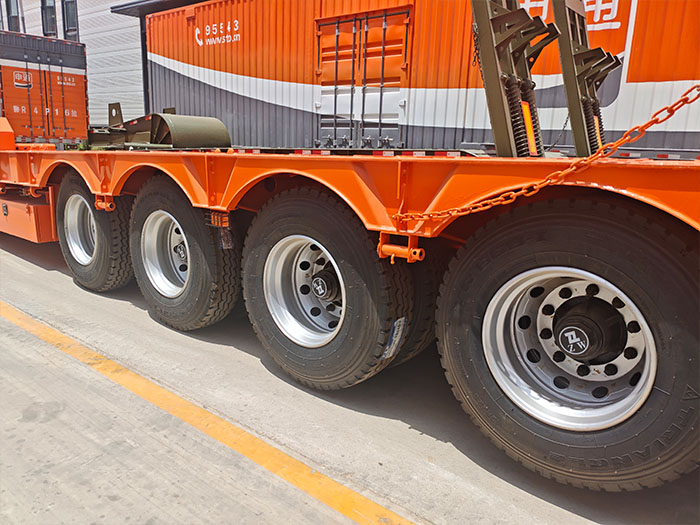
How Proper Axle Spacing Improves Stability
Axle spacing is often overlooked during procurement, yet it directly influences turning radius, tire wear and chassis stability. For heavy-duty four axle trailers, engineering practice recommends an axle spacing of approximately 1310 mm or 1360 mm. This configuration distributes loads more evenly while reducing lateral tire scrub during tight cornering. A wider wheel track of approximately 1840 mm further improves rollover resistance, especially when transporting high-center-of-gravity equipment such as drilling rigs, crushers and tracked excavators. Combined with a reinforced mechanical suspension system, optimized axle spacing increases operational stability on uneven roads and reduces structural fatigue over long-term service.
Need a Trailer Designed for Your Equipment?
Our engineering team can recommend the ideal axle configuration, suspension design, tire specification and frame reinforcement based on your equipment model and transport route. Whether you are shipping a Caterpillar 349, Komatsu PC1250, Volvo EC950, mining bulldozer or oversized drilling equipment, we provide customized engineering solutions rather than one-size-fits-all trailers.
✔ Free technical consultation
✔ Customized CAD drawings
✔ FOB, CFR and CIF quotations
✔ Production photos and factory inspection reports
✔ Export support for Africa, the Middle East, Southeast Asia and South America
Why Is the Gooseneck Structure the Most Critical Part of a 4 Axle Low Bed Semi Trailer?
The gooseneck is the highest stress concentration area on any heavy-duty low bed semi trailer. During acceleration, emergency braking, sharp cornering and uneven road conditions, nearly all longitudinal forces are transferred through the kingpin into the gooseneck before being distributed to the main beams. If the gooseneck is under-designed, structural fatigue will normally appear long before any visible damage develops on the trailer deck. Small cracks around the kingpin plate, deformation of the upper flange and weld separation at the transition section are common warning signs that the trailer has exceeded its structural capacity. Professional heavy-haul trailers intended for mining operations therefore use reinforced gooseneck structures rather than simply increasing steel thickness. Proper engineering distributes stress instead of concentrating it.
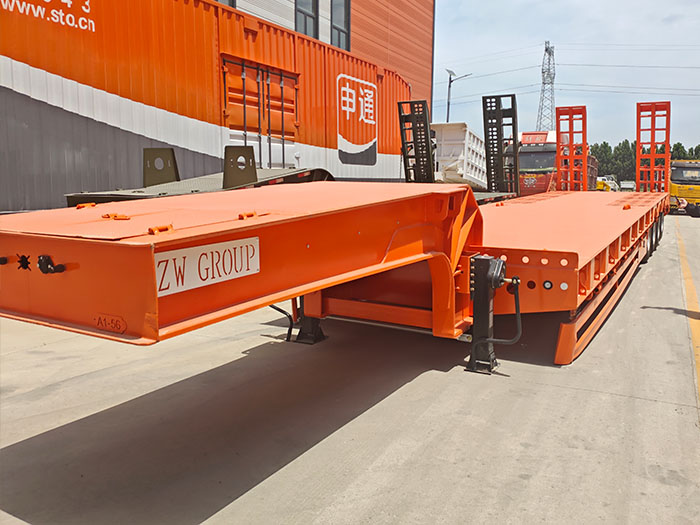
Recommended Gooseneck Engineering Specification
| Component | Recommended Design | Purpose |
|---|---|---|
| Kingpin | JOST 2" or 3.5" | Reliable connection with prime mover fifth wheel |
| Upper Plate | 16–20 mm High-Tensile Steel | Resists repeated impact loading |
| Internal Reinforcement | Double Web Plate | Reduces stress concentration |
| Cross Members | Continuous Reinforced Structure | Improves torsional rigidity |
Why High-Tensile Steel Is Better Than Simply Using Thicker Steel
Many buyers assume that a thicker beam automatically means a stronger trailer. In reality, structural performance depends on both material properties and engineering design. High-quality manufacturers use Q345B, HG60 or T700 high-tensile steel because these materials provide higher yield strength while maintaining excellent weldability. Proper finite element analysis allows engineers to place reinforcement exactly where stress occurs instead of increasing the weight of the entire trailer. This approach improves payload capacity, fuel efficiency and structural durability simultaneously.
Recommended Main Beam Specification for Mining Applications
Main beam height: 500–550 mm
Upper flange: 20–25 mm
Lower flange: 20–25 mm
Web plate thickness: 14–16 mm
Automatic submerged arc welding
Complete ultrasonic weld inspection before painting
Additional reinforcement around suspension mounting points
High-strength cross members throughout the loading platform
Should You Choose an Extendable Low Bed Trailer?
Extendable low bed trailers are designed for transporting wind turbine blades, bridge girders, transformers and other oversized cargo that exceeds the length of conventional trailers. However, buyers should understand that an extendable platform introduces additional structural complexity. Locking pins, sliding rails and telescopic sections become critical load-bearing components. Professional extendable trailers should use locking pins with a diameter of at least 40 mm, wear-resistant polymer liners inside the sliding channels and precision-machined locking mechanisms to prevent movement during transportation. For customers transporting only excavators or bulldozers, a fixed platform generally offers greater rigidity, lower maintenance requirements and longer service life.
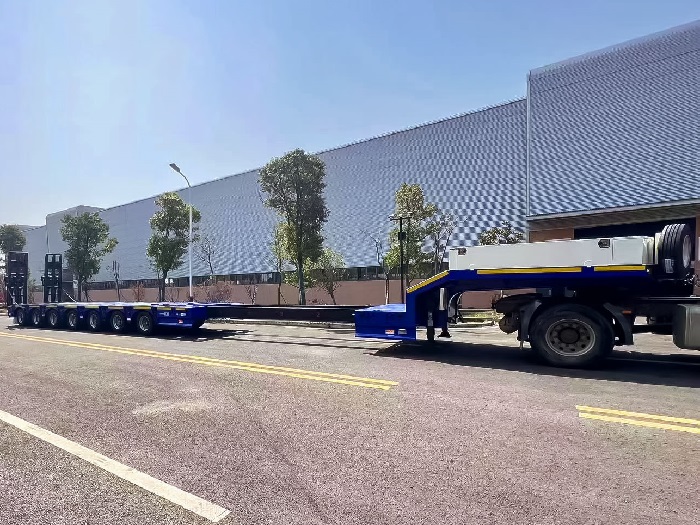
Talk Directly with Our Heavy Trailer Engineers
Every project is different. Before production begins, our engineering department analyzes your cargo dimensions, transport route, prime mover specification, local road regulations and expected service conditions. Based on this information, we recommend the most suitable beam structure, gooseneck reinforcement, suspension configuration, loading ramp and axle arrangement to maximize safety and minimize operating costs throughout the trailer's working life.
✔ Free engineering consultation
✔ Detailed technical drawings
✔ Load distribution calculation
✔ FOB / CFR / CIF quotation
✔ Factory inspection support
✔ Worldwide export experience
